The joint publication of Lyrical Ballads by William Wordsworth and Samuel Taylor Coleridge in 1798 is widely recognized as the birth of Romanticism in English literature. Both writers are among the first documented ramblers. In 1839, Thomas De Quincey, a contemporary writer and biographer of Wordsworth, famously calculated that William must have walked at least 175,000 miles up to that point in his life. Meanwhile, the Oxford English Dictionary recognizes Samuel Taylor Coleridge as being the first person to use the word “mountaineering" while describing an outing in a letter in 1802.
Wordsworth is also recognized as being an early pioneer in the conservation movement. In 1810, he published A Guide through the District of the Lakes, which likely contains the world’s first written support for the concept of a national park. In the conclusion of the book, Wordsworth argued that the Lake District should be considered “a sort of national property, in which every man has a right and interest who has an eye to perceive and a heart to enjoy.” Although his wish was never realized during his lifetime, the Lake District would eventually be established as a national park in 1951, less than a month after the Peak District became Britain’s first national park.
Learn more about the pioneers of hiking in Ramble On: A History of Hiking.
*******************************************************************************
Virtually no one went hiking before the 19th century. What occurred that inspired ordinary people to take a walk through the woods for pleasure? Ramble On: A History of Hiking explores the rich history of hiking, and how it evolved into one of the most popular pastimes in the world.
Sunday, May 24, 2026
Friday, May 22, 2026
Rocky Mountain National Park expecting more snow tonight: It's unknown when Trail Ridge Road will open
Rocky Mountain National Park posted this on their social media today:
************************************************************************************
Check out our online trail guides:
Recent spring snowstorms this week brought more snow to high elevation areas of Rocky Mountain National Park. Additional snow is in the forecast for areas above 9,000 feet tonight and tomorrow.
We are grateful for the additional moisture brought by these late spring storms.
Based on current conditions of wind-blown snow, additional snow accumulation, and icy roads, it is unknown when Trail Ridge Road will open to vehicles for through travel.
Trail Ridge Road is currently closed at Many Parks Curve on the east side of the park and at Colorado River Trailhead on the west side of the park. Keep an eye on the RMNP webpage and official social media accounts for updates. Due to an unexpected system outage, Trail Ridge Road recorded status line is currently offline.
Thank you to the RMNP Roads Crew for their continued hard work this spring!
************************************************************************************
Check out our online trail guides:
- Glacier National Park: HikinginGlacier.com
- Grand Teton National Park: TetonHikingTrails.com
- Rocky Mountain National Park: RockyMountainHikingTrails.com
- My new edition on hiking history is available on Amazon
Thursday, May 21, 2026
The first external frame rucksack
In 1887, Henry C. Merriam patented the first external frame rucksack. During the Civil War, Merriam was assigned command of the U.S. Colored Troops in Louisiana, and led them during the Siege of Port Hudson, as well as a strategically important attack on Confederate positions during the Battle of Fort Blakely in Alabama. He was later awarded the Medal of Honor for making his “most gallant assault” during the battle, which was the last major conflict of the war. Though he was a colonel in the U.S. Army when he received the patent, Merriam retired as a major general in 1901. His innovative pack was made with drab duck canvas, which was attached to a light steel frame. In addition to two shoulder straps, the pack featured several leather straps that allowed an infantryman to attach his bedroll and canteen to the frame, instead of having them rest on his chest and hips. The most important feature, however, were the two hardwood rods that extended from the sides of the pack to leather pockets on a half-belt, which rested across the lower back and hips. This system allowed the pack to elevate off the back and shoulders, and thus transfer the weight of the load onto the hips. Though he tried in vain to sell his invention to the U.S. Army, he was only able to sell a few thousand packs to the New York National Guard, and the French and Austrian armies. To his lifelong dismay, the pack never caught on as expected. Here’s a U.S. Infantry soldier demonstrating the Meriam Pack:
You can read about the evolution of backpacks – from “Otzi the Iceman’s” wooden frame rucksack to Greg Lowe’s internal frame pack - in Ramble On: A History of Hiking.
*******************************************************************************
Virtually no one went hiking before the 19th century. What occurred that inspired ordinary people to take a walk through the woods for pleasure? Ramble On: A History of Hiking explores the rich history of hiking, and how it evolved into one of the most popular pastimes in the world.
You can read about the evolution of backpacks – from “Otzi the Iceman’s” wooden frame rucksack to Greg Lowe’s internal frame pack - in Ramble On: A History of Hiking.
*******************************************************************************
Virtually no one went hiking before the 19th century. What occurred that inspired ordinary people to take a walk through the woods for pleasure? Ramble On: A History of Hiking explores the rich history of hiking, and how it evolved into one of the most popular pastimes in the world.
Wednesday, May 20, 2026
Colorado Experience: Building the Colorado Trail
Heads up! Rocky Mountain PBS will be airing "Building The Colorado Trail" tomorrow evening. I received this email from The Colorado Trail Foundation today:
************************************************************************************
Check out our online trail guides:
Don't miss the Rocky Mountain PBS documentary "Building The Colorado Trail", tomorrow Thursday, May 21 at 7 pm!Here's the trailer:
The film is part of the Rocky Mountain PBS series, The Colorado Experience, and details the building and maintenance of The Colorado Trail. Don't miss this opportunity to learn more about the history of your favorite trail and see a few familiar faces.
Save The Date:
If you miss the Thursday premier, then save the date for July 16th in Golden, Colorado as we will be teaming up with The Colorado Mountain Club for a special live viewing. Look for more details soon about how to join us for a wonderful evening of fun and film.
************************************************************************************
Check out our online trail guides:
- Glacier National Park: HikinginGlacier.com
- Grand Teton National Park: TetonHikingTrails.com
- Rocky Mountain National Park: RockyMountainHikingTrails.com
- My new edition on hiking history is available on Amazon
Random photos from New Mexico
Last week, Kathy and I returned from from our trip to New Mexico. Here are a few photos from the trip (all taken by Kathy).
In the spirit of the 100th anniversary of Route 66, we stopped at the Route 66 Auto Museum in Santa Rosa: The view from Atalaya Mountain north of Santa Fe: A bone fragment from St. Francis Xavier (patron of the greatest university in America!), exhibited in The Cathedral Basilica of St. Francis of Assisi in Santa Fe: A mariachi band at the Del Charro Saloon in Santa Fe. Great music, and a great quesadilla! The famous spiral staircase in the Loretto Chapel in Santa Fe. Its existence and construction is a pretty amazing story: The San Francisco de Asis church in Taos. This adobe mission was constructed between 1772 and 1816. Ansel Adams took several iconic photos of the church in 1929. If you ever get a chance to visit this wonderful site, be sure to stop for lunch at the Ranchos Plaza Grill. You won't regret it... The Rio Grande Gorge bridge stands 650 feet above the river below, making it the fifth highest bridge in the United States. This is the original “Bridge to Nowhere.” During its construction in the 1960s, funding didn't exist to continue the road on the other side, thus leading to its nickname. There's a trail that extends south from the bridge for several miles if you wish to see this incredible geological feature up close. The gorge has the appearance of being a crack in the Earth's crust: On our final day in the state, we intended to hike to Gold Hill near Wheeler Peak. Unfortunately, lingering snow pack conspired to thwart our plans. At roughly the 2.75-mile mark we began to encounter snow patches, which proceeded to get worse the higher we climbed. At roughly the four-mile mark, we finally threw in the towel. We thought we would rise above the treeline at some point, and thus out of the snow, but there was no end in sight. As we descended from our highpoint we snapped a few photos in a small meadow that looked towards Wheeler Peak and the Taos Ski area. Though the photo below seemingly indicates that massive amounts of snow were still around at this point, this view is of the north side of those mountains. We were climbing the south side of Gold Hill. The Taos Ski area webcam showed very little snow on Gold Hill the day before, but the trees at the mid elevations hid the lingering snow.
************************************************************************************
Check out our online trail guides:
In the spirit of the 100th anniversary of Route 66, we stopped at the Route 66 Auto Museum in Santa Rosa: The view from Atalaya Mountain north of Santa Fe: A bone fragment from St. Francis Xavier (patron of the greatest university in America!), exhibited in The Cathedral Basilica of St. Francis of Assisi in Santa Fe: A mariachi band at the Del Charro Saloon in Santa Fe. Great music, and a great quesadilla! The famous spiral staircase in the Loretto Chapel in Santa Fe. Its existence and construction is a pretty amazing story: The San Francisco de Asis church in Taos. This adobe mission was constructed between 1772 and 1816. Ansel Adams took several iconic photos of the church in 1929. If you ever get a chance to visit this wonderful site, be sure to stop for lunch at the Ranchos Plaza Grill. You won't regret it... The Rio Grande Gorge bridge stands 650 feet above the river below, making it the fifth highest bridge in the United States. This is the original “Bridge to Nowhere.” During its construction in the 1960s, funding didn't exist to continue the road on the other side, thus leading to its nickname. There's a trail that extends south from the bridge for several miles if you wish to see this incredible geological feature up close. The gorge has the appearance of being a crack in the Earth's crust: On our final day in the state, we intended to hike to Gold Hill near Wheeler Peak. Unfortunately, lingering snow pack conspired to thwart our plans. At roughly the 2.75-mile mark we began to encounter snow patches, which proceeded to get worse the higher we climbed. At roughly the four-mile mark, we finally threw in the towel. We thought we would rise above the treeline at some point, and thus out of the snow, but there was no end in sight. As we descended from our highpoint we snapped a few photos in a small meadow that looked towards Wheeler Peak and the Taos Ski area. Though the photo below seemingly indicates that massive amounts of snow were still around at this point, this view is of the north side of those mountains. We were climbing the south side of Gold Hill. The Taos Ski area webcam showed very little snow on Gold Hill the day before, but the trees at the mid elevations hid the lingering snow.
************************************************************************************
Check out our online trail guides:
- Glacier National Park: HikinginGlacier.com
- Grand Teton National Park: TetonHikingTrails.com
- Rocky Mountain National Park: RockyMountainHikingTrails.com
- My new edition on hiking history is available on Amazon
Tuesday, May 19, 2026
More snow expected in Rocky Mountain National Park
Rocky Mountain National Park posted this on their social media today:
************************************************************************************
Check out our online trail guides:
Yesterday's spring snowstorm brought more snow to high elevation areas of Rocky Mountain National Park. This morning, there was over a foot of new snow on the ground at Rainbow Curve and snow is still falling. More snow is in the extended forecast over the next several days.
We are grateful for the additional moisture brought by this spring snowstorm.
Based on current conditions, along with incoming weather and wind in the extended forecast for high elevation areas of RMNP, it is unknown when Trail Ridge Road will open to vehicles for through travel.
Trail Ridge Road is currently closed at Many Parks Curve on the east side of the park and at Colorado River Trailhead on the west side of the park. Keep an eye on the RMNP webpage and official social media accounts for updates.
Thank you to the RMNP Roads Crew for all their hard work to clear snow from park roads!
************************************************************************************
Check out our online trail guides:
- Glacier National Park: HikinginGlacier.com
- Grand Teton National Park: TetonHikingTrails.com
- Rocky Mountain National Park: RockyMountainHikingTrails.com
- My new edition on hiking history is available on Amazon
Monday, May 18, 2026
How art inspired hiking
Though it may sound strange, or maybe even surprising, but art played an important role in the development of early American tourism and hiking. Specifically, it was a mid-nineteenth-century art movement known as the Hudson River School that celebrated the pastoral landscapes of our fledgling republic. The significance of the movement, whose artists were influenced by Romanticism and nationalism, was that it helped to usher in the acceptance and appreciation of the American landscape. It also encouraged Americans to visit the places depicted in their paintings. The founder of the movement, Thomas Cole, traveled to the Catskill Mountains for the first time in 1825. One of his first paintings, The Falls of the Kaaterskill, portrayed one of the highest waterfalls in the eastern United States, which in turn helped to make it one of America’s first tourist destinations.
Other notable artists from this genre include Albert Bierstadt and Thomas Moran, both of whom became famous for their paintings of the American West. In 1839, Cole painted A View of the Mountain Pass Called the Notch of the White Mountains (Crawford Notch), which by that point had already been established as America’s first hiking destination.
You can read about the crucial role the White Mountains of New Hampshire played in making hiking a national pastime in Ramble On: A History of Hiking.
Sunday, May 17, 2026
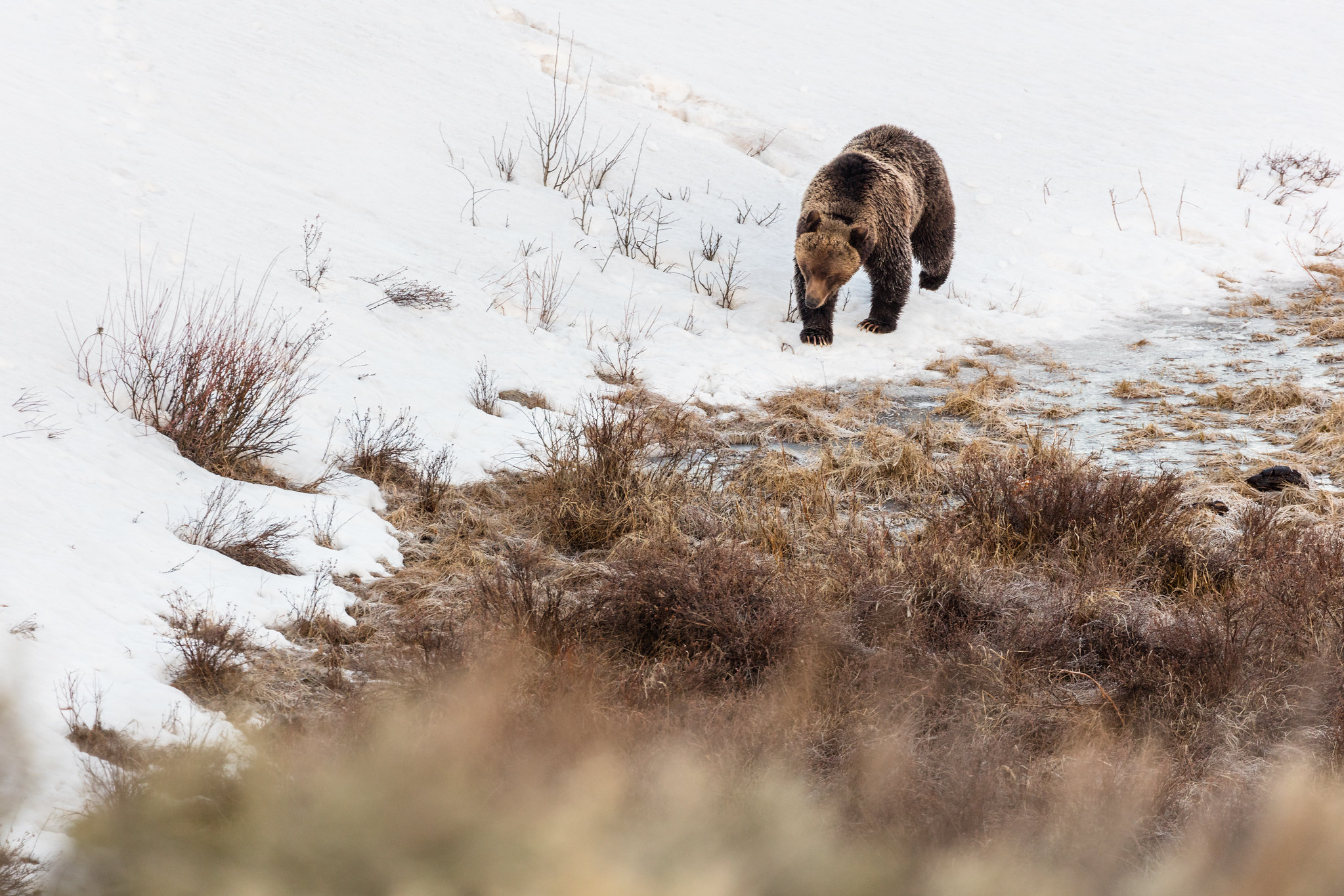
National Park Service Reminds Visitors to be Bear Aware as Spring and Summer Bear Activity Increases
The National Park Service is reminding visitors to take extra precautions in bear country following recent bear incidents in several national parks.
Spring and early summer are periods of increased bear activity in many parks. Bears may be moving through habitat, searching for food or protecting cubs. Visitors can reduce the chance of a dangerous encounter by staying alert, hiking in groups, making noise in low-visibility areas, storing food and trash properly and never approaching bears. “National parks are wild places, and wildlife safety is visitor safety,” said Jessica Bowron, Comptroller, Exercising the Delegated Authority of the Director. “Simple actions, like giving bears space, securing food and knowing what to do before you enter bear country, can protect visitors and bears.”
Visitors should check current park alerts before their trip and follow park-specific bear safety guidance. Bear species, terrain, food storage rules and bear spray recommendations vary across the National Park Service.
Core safety reminders include:
* Never approach a bear.
* Stay alert and avoid headphones on trails.
* Hike in groups when possible.
* Make noise near streams, dense vegetation and blind corners.
* Store food, trash and scented items properly.
* Carry bear spray where recommended and allowed.
* Never run from a bear.
If you encounter a bear, stay calm, speak in a steady voice, back away slowly and do not make sudden movements. Visitors should report bear encounters to park staff as soon as it is safe to do so.
For park-specific bear safety information, visit the park’s website before arrival.
************************************************************************************
Check out our online trail guides:
Spring and early summer are periods of increased bear activity in many parks. Bears may be moving through habitat, searching for food or protecting cubs. Visitors can reduce the chance of a dangerous encounter by staying alert, hiking in groups, making noise in low-visibility areas, storing food and trash properly and never approaching bears. “National parks are wild places, and wildlife safety is visitor safety,” said Jessica Bowron, Comptroller, Exercising the Delegated Authority of the Director. “Simple actions, like giving bears space, securing food and knowing what to do before you enter bear country, can protect visitors and bears.”
Visitors should check current park alerts before their trip and follow park-specific bear safety guidance. Bear species, terrain, food storage rules and bear spray recommendations vary across the National Park Service.
Core safety reminders include:
* Never approach a bear.
* Stay alert and avoid headphones on trails.
* Hike in groups when possible.
* Make noise near streams, dense vegetation and blind corners.
* Store food, trash and scented items properly.
* Carry bear spray where recommended and allowed.
* Never run from a bear.
If you encounter a bear, stay calm, speak in a steady voice, back away slowly and do not make sudden movements. Visitors should report bear encounters to park staff as soon as it is safe to do so.
For park-specific bear safety information, visit the park’s website before arrival.
************************************************************************************
Check out our online trail guides:
- Glacier National Park: HikinginGlacier.com
- Grand Teton National Park: TetonHikingTrails.com
- Rocky Mountain National Park: RockyMountainHikingTrails.com
- My new edition on hiking history is available on Amazon
Saturday, May 16, 2026
Bridge replacement project near Dream Lake completed early
Rocky Mountain National Park posted this blurb on their social media yesterday:
************************************************************************************
Check out our online trail guides:
Rocky Mountain National Park's trail crew has completed the bridge replacement project just above Nymph Lake and the trail between Nymph and Dream Lakes has reopened.
Trail crew members need to complete a few final touches, like adding the side rails, next week but the bridge is ready for use.
The trail closure that was planned for next week will not be needed. Thank you to all trail crew members for replacing this bridge and your hard work!
For more details on trail conditions in RMNP, visit https://www.nps.gov/romo/planyourvisit/trail_conditions.htm
************************************************************************************
Check out our online trail guides:
- Glacier National Park: HikinginGlacier.com
- Grand Teton National Park: TetonHikingTrails.com
- Rocky Mountain National Park: RockyMountainHikingTrails.com
- My new edition on hiking history is available on Amazon
Friday, May 15, 2026
On this date in hiking history: The most important camping trip ever
The following is an adaptation from Ramble On: A History of Hiking.
On this date in 1903, John Muir commenced a historic three-night camping trip with President Theodore Roosevelt in Yosemite. Most historians now regard this as the most important camping trip ever.
Thirty years prior, John Muir moved to Oakland, California, and began writing articles for several leading magazines that brought national attention to himself and his causes. In addition to writing about his wilderness travels, Muir lectured his readers about nature, conservation, and the preservation of wild places. He also brought attention to the damage being inflicted on wilderness as a result of the progress of man. Muir’s advocacy and influence helped to establish Yosemite, Sequoia and the General Grant Grove as national parks in 1890. In subsequent articles he promoted the creation of Petrified Forest, Grand Canyon and Mount Rainier as well, all of which eventually led to him becoming known as "The Father of our National Parks."
Muir’s writings eventually caught the attention of President Theodore Roosevelt. While touring the American West in 1903, Roosevelt arranged to meet with Muir in Yosemite. Traveling by horseback, the two men, along with two rangers and a packer guide, camped three nights in three different locations around the park.
On their first night, the party camped under the Grizzly Giant in Mariposa Grove. Roosevelt reportedly bedded down on a pile of 40 wool blankets that night. On the second night, the party camped near Sentinel Dome. That evening, a surprise late-spring snowstorm dumped 5 inches of fresh snow on the campers. The next morning, Muir and Roosevelt posed for what would become their famous photo at Glacier Point. What happened to all that snow? Perhaps it was late in the morning when the photo was taken, and thus the snow had already melted. American Heritage magazine claims that Roosevelt was overcome with emotion after witnessing the sublime beauty of the Yosemite Valley from this lofty perch. A passage in the article states:
Perhaps sensing Roosevelt was now in the proper frame of mind, Muir felt confident that he could persuade the President on his preservation views and concerns later that evening. On their third and final night in the park, the two towering figures camped along the edge of Bridalveil Meadow in the Yosemite Valley. Around the campfire that evening, Muir urged the President to return the California State grant lands of the Yosemite Valley and Mariposa Grove back to the federal government so that they could be incorporated into Yosemite National Park (established in 1890). He also spoke about the broader needs for more wilderness protections across the country. Muir later bragged to a friend that he had “stuffed [Roosevelt] pretty well regarding the timber thieves, and the destructive work of the lumbermen, and other spoilers of our forests." His lobbying efforts had their desired effect. In 1906, Roosevelt signed the Yosemite Recession Bill, which withdrew the Yosemite Valley and Mariposa Grove from the state of California and incorporated them into Yosemite National Park. Moreover, after that fateful camping trip, Roosevelt would proceed to establish 3 additional national parks, 143 national forests, 18 national monuments, 51 federal bird reserves and 4 national game preserves. In all, Roosevelt would place roughly 230 million acres of public land under federal protection during his presidency.
*******************************************************************************
Virtually no one went hiking before the 19th century. What occurred that inspired ordinary people to take a walk through the woods for pleasure? Ramble On: A History of Hiking explores the rich history of hiking, and how it evolved into one of the most popular pastimes in the world.
On this date in 1903, John Muir commenced a historic three-night camping trip with President Theodore Roosevelt in Yosemite. Most historians now regard this as the most important camping trip ever.
Thirty years prior, John Muir moved to Oakland, California, and began writing articles for several leading magazines that brought national attention to himself and his causes. In addition to writing about his wilderness travels, Muir lectured his readers about nature, conservation, and the preservation of wild places. He also brought attention to the damage being inflicted on wilderness as a result of the progress of man. Muir’s advocacy and influence helped to establish Yosemite, Sequoia and the General Grant Grove as national parks in 1890. In subsequent articles he promoted the creation of Petrified Forest, Grand Canyon and Mount Rainier as well, all of which eventually led to him becoming known as "The Father of our National Parks."
Muir’s writings eventually caught the attention of President Theodore Roosevelt. While touring the American West in 1903, Roosevelt arranged to meet with Muir in Yosemite. Traveling by horseback, the two men, along with two rangers and a packer guide, camped three nights in three different locations around the park.
On their first night, the party camped under the Grizzly Giant in Mariposa Grove. Roosevelt reportedly bedded down on a pile of 40 wool blankets that night. On the second night, the party camped near Sentinel Dome. That evening, a surprise late-spring snowstorm dumped 5 inches of fresh snow on the campers. The next morning, Muir and Roosevelt posed for what would become their famous photo at Glacier Point. What happened to all that snow? Perhaps it was late in the morning when the photo was taken, and thus the snow had already melted. American Heritage magazine claims that Roosevelt was overcome with emotion after witnessing the sublime beauty of the Yosemite Valley from this lofty perch. A passage in the article states:
Casting his eyes now on what many believed was the most spectacular panorama in the nation, the nation that he led, Roosevelt felt a welling of emotion. Not only was it a sight of awesome beauty and grandeur; it was an immense responsibility. Though, if tears streaked his face, as was reported, you would never know it from the photo. The photographer, who took two shots of the pair and two of Roosevelt alone, made sure of that.The March 1959 edition of Yosemite Nature Notes also confirms this little known tidbit in American history: “It is said that he cried from sheer emotional joy as he viewed the floor of the Valley from Glacier Point.”
Perhaps sensing Roosevelt was now in the proper frame of mind, Muir felt confident that he could persuade the President on his preservation views and concerns later that evening. On their third and final night in the park, the two towering figures camped along the edge of Bridalveil Meadow in the Yosemite Valley. Around the campfire that evening, Muir urged the President to return the California State grant lands of the Yosemite Valley and Mariposa Grove back to the federal government so that they could be incorporated into Yosemite National Park (established in 1890). He also spoke about the broader needs for more wilderness protections across the country. Muir later bragged to a friend that he had “stuffed [Roosevelt] pretty well regarding the timber thieves, and the destructive work of the lumbermen, and other spoilers of our forests." His lobbying efforts had their desired effect. In 1906, Roosevelt signed the Yosemite Recession Bill, which withdrew the Yosemite Valley and Mariposa Grove from the state of California and incorporated them into Yosemite National Park. Moreover, after that fateful camping trip, Roosevelt would proceed to establish 3 additional national parks, 143 national forests, 18 national monuments, 51 federal bird reserves and 4 national game preserves. In all, Roosevelt would place roughly 230 million acres of public land under federal protection during his presidency.
*******************************************************************************
Virtually no one went hiking before the 19th century. What occurred that inspired ordinary people to take a walk through the woods for pleasure? Ramble On: A History of Hiking explores the rich history of hiking, and how it evolved into one of the most popular pastimes in the world.
Wednesday, May 13, 2026
The significance of the Industrial Revolution on hiking
The following is an adaptation from Ramble On: A History of Hiking.
While overcoming a fear of mountains and the gradual breakdown in the social stigmas associated with walking certainly enabled hiking to germinate, I would argue that the single most important event to spur the development of hiking was the Industrial Revolution. The social changes brought about by industrialization were profound. As explained in much more detail in Ramble On: A History of Hiking, industrialization triggered a massive backlash from certain segments of society, which inspired movements in art, philosophy and religion. These movements, in turn, would motivate people - in one way or another - to visit wilderness areas for recreational purposes. As industrialization progressed, especially in America, it gave rise to the labor movement, which eventually resulted in increased wages and significant reductions in the average number of hours worked each week. Thus, workers began to enjoy more free time, many of whom pursued recreation in the great outdoors. Industrialization also gave rise to railroads, automobiles and roads, which provided people with the ability to travel more easily to wilderness areas. As a result of these social transformations and movements, hiking emerged as a pastime. Though it was only a fringe activity in the early 1800s, the sport grew steadily through the Great Depression. After World War II, however, it exploded, and has now become one of the world's most popular outdoor activities.
Learn more about Ramble On: A History of Hiking on my author page.
*******************************************************************************
Virtually no one went hiking before the 19th century. What occurred that inspired ordinary people to take a walk through the woods for pleasure? Ramble On: A History of Hiking explores the rich history of hiking, and how it evolved into one of the most popular pastimes in the world.
While overcoming a fear of mountains and the gradual breakdown in the social stigmas associated with walking certainly enabled hiking to germinate, I would argue that the single most important event to spur the development of hiking was the Industrial Revolution. The social changes brought about by industrialization were profound. As explained in much more detail in Ramble On: A History of Hiking, industrialization triggered a massive backlash from certain segments of society, which inspired movements in art, philosophy and religion. These movements, in turn, would motivate people - in one way or another - to visit wilderness areas for recreational purposes. As industrialization progressed, especially in America, it gave rise to the labor movement, which eventually resulted in increased wages and significant reductions in the average number of hours worked each week. Thus, workers began to enjoy more free time, many of whom pursued recreation in the great outdoors. Industrialization also gave rise to railroads, automobiles and roads, which provided people with the ability to travel more easily to wilderness areas. As a result of these social transformations and movements, hiking emerged as a pastime. Though it was only a fringe activity in the early 1800s, the sport grew steadily through the Great Depression. After World War II, however, it exploded, and has now become one of the world's most popular outdoor activities.
Learn more about Ramble On: A History of Hiking on my author page.
*******************************************************************************
Virtually no one went hiking before the 19th century. What occurred that inspired ordinary people to take a walk through the woods for pleasure? Ramble On: A History of Hiking explores the rich history of hiking, and how it evolved into one of the most popular pastimes in the world.
Monday, May 11, 2026
On this date in hiking history: Glacier becomes America’s 8th national park
On this date in 1910, Glacier became America’s 8th national park. Take a step back in time and check out this quick tour of the park from the 1920s:
*******************************************************************************
Glacier National Park preserves more than a million acres of some of the most spectacular scenery on Earth. With more than 740 miles of trails meandering throughout this vast park, how will you find and choose the most scenic and rewarding hikes?
Exploring Glacier National Park takes all the guesswork out by focusing on the most amazing hikes, and provides you with handpicked recommendations that will allow you to make the most of your trip to Glacier:
*******************************************************************************
Glacier National Park preserves more than a million acres of some of the most spectacular scenery on Earth. With more than 740 miles of trails meandering throughout this vast park, how will you find and choose the most scenic and rewarding hikes?
Exploring Glacier National Park takes all the guesswork out by focusing on the most amazing hikes, and provides you with handpicked recommendations that will allow you to make the most of your trip to Glacier:
Wednesday, May 6, 2026
CPW to implement out-of-state vehicle license plate daily parks pass
The Parks and Wildlife Commission (PWC) recently approved a parks pass specifically for vehicles with out-of-state license plates for $15 per day. This fee goes into effect on May 1, 2026. A similar fee structure is used on other CPW products and is in line with other states.
Vehicles with Colorado license plates can still purchase the annual Keep Colorado Wild pass with their vehicle registration for $29 per year, or purchase a daily park pass for $10 per day.
At Chatfield, Elkhead Reservoir, Golden Gate Canyon, Pearl Lake, Stagecoach, State Forest, and Steamboat Lake State Parks, there is an additional $2 fee for both resident and out-of-state plates.
************************************************************************************
Check out our online trail guides:
Vehicles with Colorado license plates can still purchase the annual Keep Colorado Wild pass with their vehicle registration for $29 per year, or purchase a daily park pass for $10 per day.
At Chatfield, Elkhead Reservoir, Golden Gate Canyon, Pearl Lake, Stagecoach, State Forest, and Steamboat Lake State Parks, there is an additional $2 fee for both resident and out-of-state plates.
************************************************************************************
Check out our online trail guides:
- Glacier National Park: HikinginGlacier.com
- Grand Teton National Park: TetonHikingTrails.com
- Rocky Mountain National Park: RockyMountainHikingTrails.com
- My new edition on hiking history is available on Amazon
Monday, May 4, 2026
A Young Granite Park Chalet
The two photos below of the Granite Park Chalet in Glacier National Park were taken by T. J. Hileman in 1925, just ten years after it was constructed by the Great Northern Railway. The rustic lodge was the last of the nine backcountry chalets built by the railroad, all of which were part of an interconnected system of trails, tent camps, backcountry chalets and frontcountry lodges [more details on this system here]. All were constructed to provide comfortable accommodations within Glacier during the era before automobile travel become an important mode of transportation. Both Sperry and Granite Park, the only chalets that survive to this day, still offer overnight accommodations for hikers. Both are National Historic Landmarks.
Compared to Sperry Chalet, the Granite Park Chalet is much more basic, and is essentially a simple hiker's hostel, with virtually no amenities. It has 12 guest rooms, each with 2 to 6 bunks. Although there's no electricity, the common-area kitchen does have a propane stove that you can use to cook a warm lunch or dinner. The chalet also sells packaged foods, beverages, snacks, and bottled water to day hikers.
Although accommodations are limited, the chalet is still a popular destination for hikers on the Highline Trail, as the upfront views of Heavens Peak are second to none:
Here's another photo of a "man playing with bear at Granite Chalet" in 1924. This photo was taken by John Morten:
*******************************************************************************
Glacier National Park preserves more than a million acres of some of the most spectacular scenery on Earth. With more than 740 miles of trails meandering throughout this vast park, how will you find and choose the most scenic and rewarding hikes?
Exploring Glacier National Park takes all the guesswork out by focusing on the most amazing hikes, and provides you with handpicked recommendations that will allow you to make the most of your trip to Glacier:
Compared to Sperry Chalet, the Granite Park Chalet is much more basic, and is essentially a simple hiker's hostel, with virtually no amenities. It has 12 guest rooms, each with 2 to 6 bunks. Although there's no electricity, the common-area kitchen does have a propane stove that you can use to cook a warm lunch or dinner. The chalet also sells packaged foods, beverages, snacks, and bottled water to day hikers.
Although accommodations are limited, the chalet is still a popular destination for hikers on the Highline Trail, as the upfront views of Heavens Peak are second to none:
Here's another photo of a "man playing with bear at Granite Chalet" in 1924. This photo was taken by John Morten:
*******************************************************************************
Glacier National Park preserves more than a million acres of some of the most spectacular scenery on Earth. With more than 740 miles of trails meandering throughout this vast park, how will you find and choose the most scenic and rewarding hikes?
Exploring Glacier National Park takes all the guesswork out by focusing on the most amazing hikes, and provides you with handpicked recommendations that will allow you to make the most of your trip to Glacier:
Saturday, May 2, 2026
Check trail conditions in Rocky Mountain National Park
Rocky Mountain National Park posted this blurb on their social media yesterday:
************************************************************************************
Check out our online trail guides:
Following a recent winter storm, many trails in Rocky Mountain National Park are now covered with a new layer of snow and ice. Did you remember to bring a set of traction devices?
Traction devices come in many different styles and are a great tool to help prevent slips and falls when hiking on icy trails. These devices attach to the bottom of your hiking boots and give you traction. Hiking poles are also very helpful.
This weekend, expect snow on the Bear Lake Nature Trail, as well as the trail to Nymph, Dream, and Emerald Lakes and most other high elevation destinations inside RMNP.
For information on current trail conditions, visit https://www.nps.gov/romo/planyourvisit/trail_conditions.htm
The park's trail conditions report is best used as a general guide. Conditions on trails can change rapidly, based on weather and other factors. Trail conditions can vary from what was last described in this report.
************************************************************************************
Check out our online trail guides:
- Glacier National Park: HikinginGlacier.com
- Grand Teton National Park: TetonHikingTrails.com
- Rocky Mountain National Park: RockyMountainHikingTrails.com
- My new edition on hiking history is available on Amazon
Thursday, April 30, 2026
The Surprising History of Pedometers
The following is an adaptation from Ramble On: A History of Hiking.
While conducting research for my book I came across an enlightening article in the June 1877 edition of Appalachia, the journal of the Appalachian Mountain Club. According to the piece, much discussion was given to the pedometer during a previous club meeting. Like today, the pedometer counts the number of steps one takes while walking to calculate the total distance covered during a trip. And like today, the owner of the instrument had to accurately measure their average stride in order to obtain a relatively accurate reading of their mileage. Interestingly, at that time, the cost of a pedometer was $15.00, which is roughly equivalent to the price of a modern version of the same device.
To be honest, I was quite surprised to learn that the pedometer existed at that time. Even more surprising was learning that the device has been around for hundreds of years! As far back as the fifteenth century, artist and inventor Leonardo da Vinci sketched plans for an apparatus that could track the distance soldiers walked, and possibly as an aid for improving the accuracy of maps. Though it’s generally believed that his drawings never materialized into a working prototype, an apparatus that counted steps was invented shortly after his death. In 1525, French physician Jean Fernel created a device that resembled a pocket watch. It had four dials (units, tens, hundreds, and thousands) that were connected by a mechanism that attached to the user’s belt. A cord was then attached to the user’s knee so that it would pull on the device every time a step was taken. Though the precise timing is a little murky, Fernel also created a device that counted the number of revolutions of a carriage wheel. Specifically, he used this to measure the distance and the degree of the arc of the meridian between Paris and Amiens, which ultimately allowed him to calculate the circumference of the earth. It’s not clear if the two devices were developed in conjunction with each other, or one invention preceded the other. Depending on which history you read, his carriage wheel counter was invented in either 1525, 1527 or 1528.
Other devices would follow. In fact, the Germanic National Museum in Nuremberg has a pedometer in its collection from around 1590: Similar in function to Fernel’s invention, London watchmaker Spencer & Perkins sold a pocket watch style pedometer between 1775 and 1794. In 1777, Swiss watchmaker Abraham-Louis Perrelet invented the world’s first automatic winding watch. This timepiece used an oscillating weight within the watch that moved up-and-down while walking. Building upon this technology, he introduced a pedometer three years later: While in Paris, between 1784 and 1789, Thomas Jefferson commissioned a local watchmaker to craft a custom-made step counter for his personal use. The device was worn in a vest pocket, which was connected by string to a strap worn below the knee. Each time Jefferson took a step, the string would pull a protruding lever arm attached to the gears on the counter, and thus be recorded. In 1788, he sent a replica to James Madison, along with detailed instructions on how to use it. Unfortunately, neither of those devices exists anymore.
*******************************************************************************
Virtually no one went hiking before the 19th century. What occurred that inspired ordinary people to take a walk through the woods for pleasure? Ramble On: A History of Hiking explores the rich history of hiking, and how it evolved into one of the most popular pastimes in the world.
While conducting research for my book I came across an enlightening article in the June 1877 edition of Appalachia, the journal of the Appalachian Mountain Club. According to the piece, much discussion was given to the pedometer during a previous club meeting. Like today, the pedometer counts the number of steps one takes while walking to calculate the total distance covered during a trip. And like today, the owner of the instrument had to accurately measure their average stride in order to obtain a relatively accurate reading of their mileage. Interestingly, at that time, the cost of a pedometer was $15.00, which is roughly equivalent to the price of a modern version of the same device.
To be honest, I was quite surprised to learn that the pedometer existed at that time. Even more surprising was learning that the device has been around for hundreds of years! As far back as the fifteenth century, artist and inventor Leonardo da Vinci sketched plans for an apparatus that could track the distance soldiers walked, and possibly as an aid for improving the accuracy of maps. Though it’s generally believed that his drawings never materialized into a working prototype, an apparatus that counted steps was invented shortly after his death. In 1525, French physician Jean Fernel created a device that resembled a pocket watch. It had four dials (units, tens, hundreds, and thousands) that were connected by a mechanism that attached to the user’s belt. A cord was then attached to the user’s knee so that it would pull on the device every time a step was taken. Though the precise timing is a little murky, Fernel also created a device that counted the number of revolutions of a carriage wheel. Specifically, he used this to measure the distance and the degree of the arc of the meridian between Paris and Amiens, which ultimately allowed him to calculate the circumference of the earth. It’s not clear if the two devices were developed in conjunction with each other, or one invention preceded the other. Depending on which history you read, his carriage wheel counter was invented in either 1525, 1527 or 1528.
Other devices would follow. In fact, the Germanic National Museum in Nuremberg has a pedometer in its collection from around 1590: Similar in function to Fernel’s invention, London watchmaker Spencer & Perkins sold a pocket watch style pedometer between 1775 and 1794. In 1777, Swiss watchmaker Abraham-Louis Perrelet invented the world’s first automatic winding watch. This timepiece used an oscillating weight within the watch that moved up-and-down while walking. Building upon this technology, he introduced a pedometer three years later: While in Paris, between 1784 and 1789, Thomas Jefferson commissioned a local watchmaker to craft a custom-made step counter for his personal use. The device was worn in a vest pocket, which was connected by string to a strap worn below the knee. Each time Jefferson took a step, the string would pull a protruding lever arm attached to the gears on the counter, and thus be recorded. In 1788, he sent a replica to James Madison, along with detailed instructions on how to use it. Unfortunately, neither of those devices exists anymore.
*******************************************************************************
Virtually no one went hiking before the 19th century. What occurred that inspired ordinary people to take a walk through the woods for pleasure? Ramble On: A History of Hiking explores the rich history of hiking, and how it evolved into one of the most popular pastimes in the world.
Tuesday, April 28, 2026
Timed entry reservations reminder from RMNP
Rocky Mountain National Park posted this blurb on their social media yesterday:
************************************************************************************
Check out our online trail guides:
It's time to get ready and plan ahead for summer trips to Rocky Mountain National Park!
During certain hours of the day, beginning on Friday, May 22, a timed entry reservations will be required to enter RMNP. There are two reservation options available to choose from: Timed Entry or Timed Entry+ Bear Lake Road.
Beginning at 8 a.m. MDT on May 1, timed entry reservations will be available to reserve on https://www.recreation.gov/timed-entry/10086910 for the dates of May 22 - June 30, 2026.
Now is a great time to plan for upcoming trips and think about which reservation option is best for you. It is also a great time to update your Recreation.gov account or set up a new account.
To learn more, visit us at https://go.nps.gov/romo/timedentry
************************************************************************************
Check out our online trail guides:
- Glacier National Park: HikinginGlacier.com
- Grand Teton National Park: TetonHikingTrails.com
- Rocky Mountain National Park: RockyMountainHikingTrails.com
- My new edition on hiking history is available on Amazon
Monday, April 27, 2026
Happy Grandma Gatewood Day!
Today is Emma "Grandma" Gatewood Day! In 2012, the Ohio General Assembly officially declared April 27th as Emma "Grandma" Gatewood Day to honor the Ohio native.
So, who exactly is Grandma Gatewood? In 1955, after raising 11 children, Emma "Grandma" Gatewood became the first woman to solo thru-hike the Appalachian Trail - at the tender age of 67! In September of that year, having survived a rattlesnake strike, two hurricanes and a run-in with gangsters from Harlem, she stood atop Maine’s Mount Katahdin. Upon completion, she reportedly sang the first verse of "America the Beautiful," and then exclaimed, "I did it. I said I'd do it and I've done it."
Then, in 1957, she hiked the trail again, becoming the first person to thru-hike the Appalachian Trail twice. And, just to prove those first two weren't a fluke, she hiked it again in 1964 - at the age of 76! After the third excursion Emma became the first person to hike the 2,179-mile trail on three different occasions.
This video below provides a few insights into Gatewood's life, tribulations & achievements:
You can read more about the pioneers of hiking in Ramble On: A History of Hiking.
*******************************************************************************
Virtually no one went hiking before the 19th century. What occurred that inspired ordinary people to take a walk through the woods for pleasure? Ramble On: A History of Hiking explores the rich history of hiking, and how it evolved into one of the most popular pastimes in the world.
So, who exactly is Grandma Gatewood? In 1955, after raising 11 children, Emma "Grandma" Gatewood became the first woman to solo thru-hike the Appalachian Trail - at the tender age of 67! In September of that year, having survived a rattlesnake strike, two hurricanes and a run-in with gangsters from Harlem, she stood atop Maine’s Mount Katahdin. Upon completion, she reportedly sang the first verse of "America the Beautiful," and then exclaimed, "I did it. I said I'd do it and I've done it."
Then, in 1957, she hiked the trail again, becoming the first person to thru-hike the Appalachian Trail twice. And, just to prove those first two weren't a fluke, she hiked it again in 1964 - at the age of 76! After the third excursion Emma became the first person to hike the 2,179-mile trail on three different occasions.
This video below provides a few insights into Gatewood's life, tribulations & achievements:
You can read more about the pioneers of hiking in Ramble On: A History of Hiking.
*******************************************************************************
Virtually no one went hiking before the 19th century. What occurred that inspired ordinary people to take a walk through the woods for pleasure? Ramble On: A History of Hiking explores the rich history of hiking, and how it evolved into one of the most popular pastimes in the world.
Friday, April 24, 2026
On this day in hiking history: The Kinder Scout Mass Trespass
The following is an adaptation from Ramble On: A History of Hiking.
The “right to roam” is the concept that every individual has a right to walk through open country. In general, this means being able to access privately owned land and undeveloped wilderness areas for recreational purposes. Of course there are certain exclusions and protections for landowners, depending on the laws and customs of each country. For instance, most, if not all, countries restrict the general public from walking in close proximity to homes, or through the cultivated fields of farmers. For the most part, the right to roam has never really been an issue for hikers in the United States. However, individuals have been restricted as to where they can walk in much of Europe. With the exceptions of Scandinavia and a few other northern European countries, much of Europe developed out of feudalism, which meant that vast swaths of land were owned by the nobility classes. As the Industrial Revolution took root, especially in England, workers living in large cities began seeking the countryside to gain relief from pollution and congested urban centers. In response to what they saw as trespassing, wealthy land barons began fencing people out. In 1604, the British Parliament passed the first in a series of laws that would become known as the Enclosure Acts. By 1914, they had enacted more than 5200 enclosure laws that effectively closed off 6.8 million acres, or roughly one-fifth of England’s total landmass, thus making it illegal for the general public to walk across areas that were previously considered common lands. Exacerbating the situation, large publicly owned spaces were extremely rare throughout much of Europe, especially in Great Britain. By 1900, American hikers had access to tens of millions of acres in national parks and forests. On the contrary, the first national park in Great Britain wasn’t established until 1951. France designated its first national park in 1963, Germany in 1970, while Austria didn't establish its first national park until 1981. To combat what they saw as an infringement on their basic right to roam, hikers in Great Britain began organizing and committing acts of civil disobedience. By 1824, the first of several associations were formed to advocate for public access to local forests and other common and undeveloped lands. In 1874, the Liverpool YMCA Rambling Club was formed, which became the first of several rambling clubs to organize during the late nineteenth and early twentieth centuries. Most of these clubs actively campaigned for the right to roam, sometimes resulting in violent conflicts with landowners. One group in particular, the Sunday Tramps, was known for purposely trespassing on private lands during their weekly excursions. The group was formed in 1879 by Sir Leslie Stephen, one of the most famous British climbers during the Golden Age of Alpinism, who also served as the fourth president of the Alpine Club in the mid-1860s. Other mass intrusions would follow, including the Kinder Scout mass trespass on April 24, 1932, which resulted in the arrests of six of its leaders. It’s estimated that roughly 400 ramblers were involved in this incident. Although it was considered a highly controversial tactic at the time, the conviction and subsequent imprisonment (between 2 and 6 months) of some of its participants led to wide public outrage, which helped to increase support for access to open lands. This event is widely recognized as a turning point in the establishment of the right to roam. During the ensuing decades, several laws have been passed that have improved walkers’ rights to access open lands, culminating with the passage of the Countryside and Rights of Way Act in 2000. However, the battle between hikers and landowners continues to this day, each asserting their rights that conflict in one way or another with the other side.
*******************************************************************************
Virtually no one went hiking before the 19th century. What occurred that inspired ordinary people to take a walk through the woods for pleasure? Ramble On: A History of Hiking explores the rich history of hiking, and how it evolved into one of the most popular pastimes in the world.
The “right to roam” is the concept that every individual has a right to walk through open country. In general, this means being able to access privately owned land and undeveloped wilderness areas for recreational purposes. Of course there are certain exclusions and protections for landowners, depending on the laws and customs of each country. For instance, most, if not all, countries restrict the general public from walking in close proximity to homes, or through the cultivated fields of farmers. For the most part, the right to roam has never really been an issue for hikers in the United States. However, individuals have been restricted as to where they can walk in much of Europe. With the exceptions of Scandinavia and a few other northern European countries, much of Europe developed out of feudalism, which meant that vast swaths of land were owned by the nobility classes. As the Industrial Revolution took root, especially in England, workers living in large cities began seeking the countryside to gain relief from pollution and congested urban centers. In response to what they saw as trespassing, wealthy land barons began fencing people out. In 1604, the British Parliament passed the first in a series of laws that would become known as the Enclosure Acts. By 1914, they had enacted more than 5200 enclosure laws that effectively closed off 6.8 million acres, or roughly one-fifth of England’s total landmass, thus making it illegal for the general public to walk across areas that were previously considered common lands. Exacerbating the situation, large publicly owned spaces were extremely rare throughout much of Europe, especially in Great Britain. By 1900, American hikers had access to tens of millions of acres in national parks and forests. On the contrary, the first national park in Great Britain wasn’t established until 1951. France designated its first national park in 1963, Germany in 1970, while Austria didn't establish its first national park until 1981. To combat what they saw as an infringement on their basic right to roam, hikers in Great Britain began organizing and committing acts of civil disobedience. By 1824, the first of several associations were formed to advocate for public access to local forests and other common and undeveloped lands. In 1874, the Liverpool YMCA Rambling Club was formed, which became the first of several rambling clubs to organize during the late nineteenth and early twentieth centuries. Most of these clubs actively campaigned for the right to roam, sometimes resulting in violent conflicts with landowners. One group in particular, the Sunday Tramps, was known for purposely trespassing on private lands during their weekly excursions. The group was formed in 1879 by Sir Leslie Stephen, one of the most famous British climbers during the Golden Age of Alpinism, who also served as the fourth president of the Alpine Club in the mid-1860s. Other mass intrusions would follow, including the Kinder Scout mass trespass on April 24, 1932, which resulted in the arrests of six of its leaders. It’s estimated that roughly 400 ramblers were involved in this incident. Although it was considered a highly controversial tactic at the time, the conviction and subsequent imprisonment (between 2 and 6 months) of some of its participants led to wide public outrage, which helped to increase support for access to open lands. This event is widely recognized as a turning point in the establishment of the right to roam. During the ensuing decades, several laws have been passed that have improved walkers’ rights to access open lands, culminating with the passage of the Countryside and Rights of Way Act in 2000. However, the battle between hikers and landowners continues to this day, each asserting their rights that conflict in one way or another with the other side.
*******************************************************************************
Virtually no one went hiking before the 19th century. What occurred that inspired ordinary people to take a walk through the woods for pleasure? Ramble On: A History of Hiking explores the rich history of hiking, and how it evolved into one of the most popular pastimes in the world.
Thursday, April 23, 2026
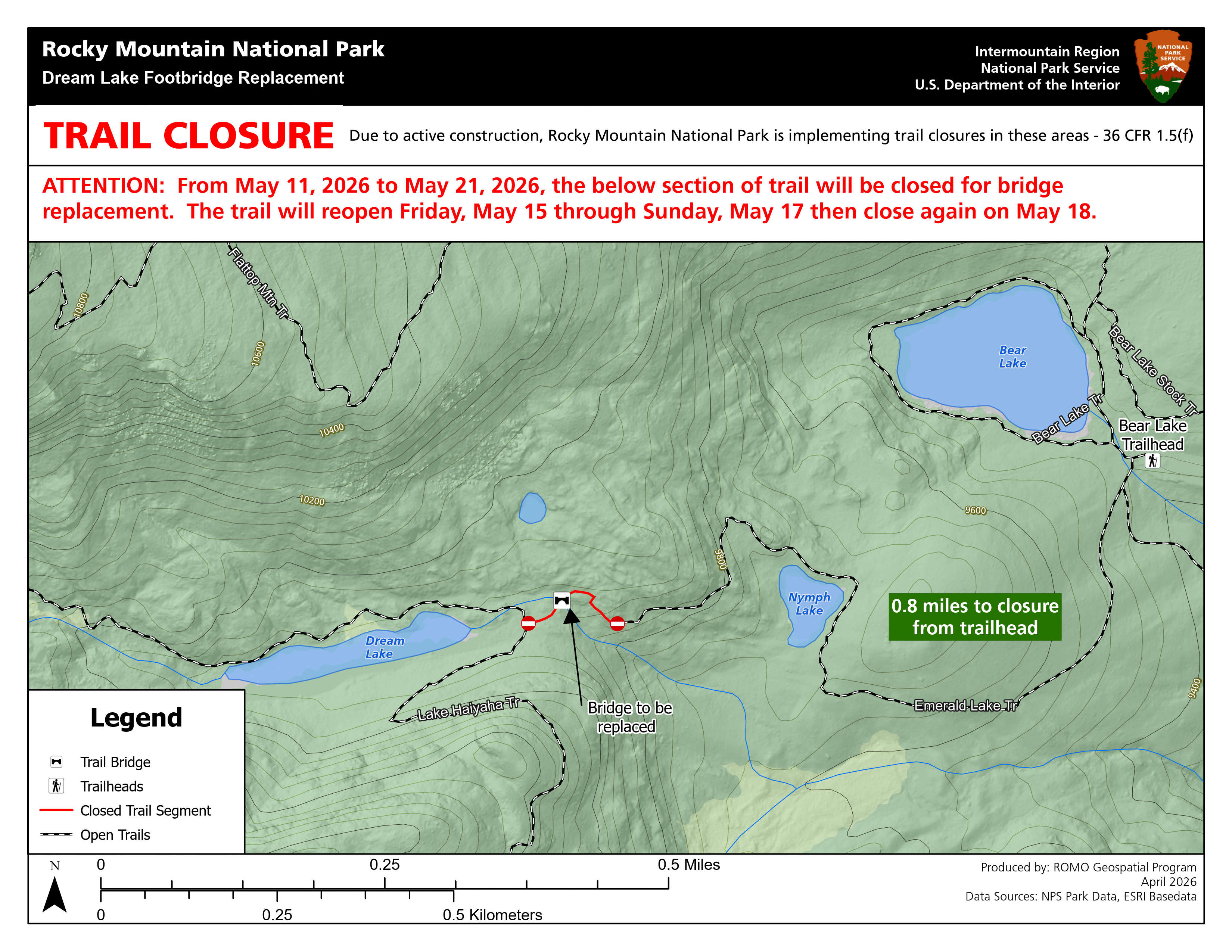
Temporary Trail Closure Above Nymph Lake For Bridge Replacement Impacting Access to Dream Lake, Emerald Lake and Lake Haiyaha
Beginning Monday, May 11 through Thursday, May 14, and then again Monday, May 18 through Thursday, May 21, trail access will be closed above Nymph Lake to the Dream Lake/Lake Haiyaha junction for a bridge replacement project. This popular trail section will reopen Friday through Sunday (May 15 through May 17) and close again on Monday, May 18 to reopen by May 21.
Dream Lake, Emerald Lake and Lake Haiyaha will only be accessible from the Lake Haiyaha Trail during this temporary closure. Park visitors should plan ahead for the additional distance to reach those destinations. All other trails in the Bear Lake area will remain open. Trail conditions can vary greatly in the spring. Be prepared for cool temperatures and varying conditions. Trails in lower elevation areas can be icy. In higher elevation areas of the park, be prepared for walking on snow and ice. Traction devices are advised in higher elevations.
************************************************************************************
Check out our online trail guides:
Dream Lake, Emerald Lake and Lake Haiyaha will only be accessible from the Lake Haiyaha Trail during this temporary closure. Park visitors should plan ahead for the additional distance to reach those destinations. All other trails in the Bear Lake area will remain open. Trail conditions can vary greatly in the spring. Be prepared for cool temperatures and varying conditions. Trails in lower elevation areas can be icy. In higher elevation areas of the park, be prepared for walking on snow and ice. Traction devices are advised in higher elevations.
************************************************************************************
Check out our online trail guides:
- Glacier National Park: HikinginGlacier.com
- Grand Teton National Park: TetonHikingTrails.com
- Rocky Mountain National Park: RockyMountainHikingTrails.com
- New and improved edition on the history of hiking is available on Amazon
Wednesday, April 22, 2026
The Early Days of Appalachian Trail Construction
Several years ago, the Appalachian Trail Museum published this historic instructional trail construction footage from the early 1930s. The video was taken by the Potomac Appalachian Trail Club, likely within the boundaries of the future Shenandoah National Park. It shows how the trail was marked, cleared, measured, signed and blazed. It also shows the construction of the Sexton Shelter. The AT Museum published the video in a three-part series.
************************************************************************************
Check out our online trail guides:
************************************************************************************
Check out our online trail guides:
- Glacier National Park: HikinginGlacier.com
- Grand Teton National Park: TetonHikingTrails.com
- Rocky Mountain National Park: RockyMountainHikingTrails.com
- My new edition on the history of hiking is available on Amazon
Monday, April 20, 2026
The Father of Rocky Mountain National Park
Mills Lake is among the most popular hiking destinations in the Bear Lake area of Rocky Mountain National Park. It's named for Enos Mills, the man commonly referred to as the "father of Rocky Mountain National Park." Mills became the area's first naturalist, and made great contributions to the field that would eventually lead to the profession of interpretive park rangers. He also established a guide service that led tourists to the summit of Longs Peak. At the age of 15 he made his first ascent of the park's highest peak, and over the course of his life, would make the trip 40 times by himself, and nearly 300 times as a guide. The photo below shows a very young Mills (on the right) making his first ascent in 1885.
Mills most significant contribution, however, was spending numerous years lecturing across the nation, lobbying Congress, and writing thousands of letters and articles that would eventually lead to the creation of Rocky Mountain National Park. By the early 1900s, Mills was beginning to worry about the increasing number of visitors in the Rocky Mountains, many of whom were not respecting the natural environment. His advocacy for protection of nature and wilderness eventually caught the attention of President Theodore Roosevelt, who appointed him to the position of Government Lecturer on Forestry. During his tenure in this position, between 1907 to 1909, he gave 2118 addresses!
Although he advocated for a national park that would extend from Wyoming to Pikes Peak, covering roughly 1000 square miles, the original park that was authorized on January 26, 1915, protected only 358 square miles. Today, the park protects roughly 415 square miles.
*******************************************************************************
Virtually no one went hiking before the 19th century. What occurred that inspired ordinary people to take a walk through the woods for pleasure? Ramble On: A History of Hiking explores the rich history of hiking, and how it evolved into one of the most popular pastimes in the world.
Mills most significant contribution, however, was spending numerous years lecturing across the nation, lobbying Congress, and writing thousands of letters and articles that would eventually lead to the creation of Rocky Mountain National Park. By the early 1900s, Mills was beginning to worry about the increasing number of visitors in the Rocky Mountains, many of whom were not respecting the natural environment. His advocacy for protection of nature and wilderness eventually caught the attention of President Theodore Roosevelt, who appointed him to the position of Government Lecturer on Forestry. During his tenure in this position, between 1907 to 1909, he gave 2118 addresses!
Although he advocated for a national park that would extend from Wyoming to Pikes Peak, covering roughly 1000 square miles, the original park that was authorized on January 26, 1915, protected only 358 square miles. Today, the park protects roughly 415 square miles.
*******************************************************************************
Virtually no one went hiking before the 19th century. What occurred that inspired ordinary people to take a walk through the woods for pleasure? Ramble On: A History of Hiking explores the rich history of hiking, and how it evolved into one of the most popular pastimes in the world.
Saturday, April 18, 2026
Mountains 101
Okay, this might not be for everyone, but I took this online course almost a decade ago and thought it was outstanding. In my view, it definitely enhanced my visits to the mountains. The really great part about it is that it’s totally free!
The twelve 60-minute lessons in this course are provided by the University of Alberta, in partnership with Parks Canada, The Alpine Club of Canada and the Mountain Equipment Company (MEC).
The courses focus on the physical, biological, and human dimensions of mountain places in Alberta and other ranges around the world. More specifically, you’ll learn about the origins of mountains, climate and weather, flora and fauna, the effects of altitude on humans, and hazards, among many other topics. According to the University of Alberta, “We’ll be delivering your lessons from valley bottoms to mountaintops, from museums and labs, to alpine huts and other spectacular alpine sites, and we’ll do so with the help of a whole host of experts.”
“This class consists of twelve 60-minute lessons, each with a series interactive lecture videos, a set of course notes and course glossary, and recommended readings and additional resources. Each lesson also includes a short summative quiz to test your understanding.”
Moreover, you can take the lessons at your own leisure. Here’s a short overview video:
For more information, please click here.
************************************************************************************
Check out our online trail guides:
The twelve 60-minute lessons in this course are provided by the University of Alberta, in partnership with Parks Canada, The Alpine Club of Canada and the Mountain Equipment Company (MEC).
The courses focus on the physical, biological, and human dimensions of mountain places in Alberta and other ranges around the world. More specifically, you’ll learn about the origins of mountains, climate and weather, flora and fauna, the effects of altitude on humans, and hazards, among many other topics. According to the University of Alberta, “We’ll be delivering your lessons from valley bottoms to mountaintops, from museums and labs, to alpine huts and other spectacular alpine sites, and we’ll do so with the help of a whole host of experts.”
“This class consists of twelve 60-minute lessons, each with a series interactive lecture videos, a set of course notes and course glossary, and recommended readings and additional resources. Each lesson also includes a short summative quiz to test your understanding.”
Moreover, you can take the lessons at your own leisure. Here’s a short overview video:
For more information, please click here.
************************************************************************************
Check out our online trail guides:
- Glacier National Park: HikinginGlacier.com
- Grand Teton National Park: TetonHikingTrails.com
- Rocky Mountain National Park: RockyMountainHikingTrails.com
- My new edition on the history of hiking is available on Amazon
Thursday, April 16, 2026
Backcountry water filters
The following is an adaptation from my new book, Ramble On: A History of Hiking.
During the early 20th Century, Abercrombie & Fitch was considered to be the preeminent outdoor goods retailer in America. Founded in New York City in 1892, the merchant retailer began selling high-end outdoor gear and apparel through extensive catalogs in 1903. By 1907, their catalog featured a portable water filter system that's fairly similar to what backpackers use today. This particular pump was invented in 1891 by the Berkefeld Filter Company out of Hanover, Germany. It weighed 3 pounds, was 14 inches long and 3 inches wide, and could produce a quart of drinking water in one minute. Abercrombie & Fitch also sold a pocket filter made by Dr. Stebbins. This option weighed only 4 ounces, was less than 5 inches in length, and was only 1.5 inches in diameter. While the larger filter used “infusorial earth” to filter contaminates out of backcountry water, the smaller filter used chemical filter paper.
Before the Common Era, however, ancient Indians, Egyptians, Greeks and Mayans were already using filtration methods to produce better tasting water. By the mid-1700s, scientists began experimenting with various filtration methods to remove microorganisms in water.
A couple of historical references cite the invention of the Katadyn Pocket Filter in 1929 as being the first true backcountry water filter. However, it’s not known if this device was smaller, weighed less, or was more effective than the Dr. Stebbins filter.
*******************************************************************************
Virtually no one went hiking before the 19th century. What occurred that inspired ordinary people to take a walk through the woods for pleasure? Ramble On: A History of Hiking explores the rich history of hiking, and how it evolved into one of the most popular pastimes in the world.
During the early 20th Century, Abercrombie & Fitch was considered to be the preeminent outdoor goods retailer in America. Founded in New York City in 1892, the merchant retailer began selling high-end outdoor gear and apparel through extensive catalogs in 1903. By 1907, their catalog featured a portable water filter system that's fairly similar to what backpackers use today. This particular pump was invented in 1891 by the Berkefeld Filter Company out of Hanover, Germany. It weighed 3 pounds, was 14 inches long and 3 inches wide, and could produce a quart of drinking water in one minute. Abercrombie & Fitch also sold a pocket filter made by Dr. Stebbins. This option weighed only 4 ounces, was less than 5 inches in length, and was only 1.5 inches in diameter. While the larger filter used “infusorial earth” to filter contaminates out of backcountry water, the smaller filter used chemical filter paper.
Before the Common Era, however, ancient Indians, Egyptians, Greeks and Mayans were already using filtration methods to produce better tasting water. By the mid-1700s, scientists began experimenting with various filtration methods to remove microorganisms in water.
A couple of historical references cite the invention of the Katadyn Pocket Filter in 1929 as being the first true backcountry water filter. However, it’s not known if this device was smaller, weighed less, or was more effective than the Dr. Stebbins filter.
*******************************************************************************
Virtually no one went hiking before the 19th century. What occurred that inspired ordinary people to take a walk through the woods for pleasure? Ramble On: A History of Hiking explores the rich history of hiking, and how it evolved into one of the most popular pastimes in the world.
Wednesday, April 15, 2026
Denver Mountain Parks to take helm on Mount Blue Sky this summer
The road to the top of Mount Blue Sky, one of Colorado’s most popular fourteeners, will reopen Memorial Day Weekend 2026, weather permitting. America’s highest paved road has been closed since Labor Day 2024 while crews rebuilt portions of the high-alpine road to address severe buckling and water drainage issues.
The surrounding Mount Blue Sky Recreation Area includes a nature center, parking lots, restrooms, scenic views and trails through native gardens and ancient forests and sees more than 100,000 visitors annually. When the snow is cleared and the gates swing open this year, it will be Denver Mountain Parks’ employees greeting guests at the welcome station for the first time. Denver Mountain Parks will lead operations at the Mount Blue Sky Recreation Area through new agreements with the Arapaho National Forest and Denver Mountain Parks Foundation.
“Managing this complex, high-use recreation area has always been a shared stewardship effort between the National Forest, the City of Denver, and State of Colorado,” said Forest Supervisor Christopher Stubbs. “We have been working together on this mountain for more than a century. In the early years, Denver had the greater presence with their lodge and restaurants on the mountain. For the past four decades, the Forest Service has been at the helm. Now it’s Denver’s turn again. Recreation is something Denver Mountain Parks does really well, and we think visitors are going to be well-served by this strengthened partnership.”
Denver Mountain Parks, part of the City and County of Denver’s Department of Parks and Recreation, owns Echo Lake Lodge and Summit Lake Park on Mount Blue Sky. The Colorado Department of Transportation maintains State Highway 5 to the summit, including plowing and repairs. Colorado Parks and Wildlife manages the nearby wildlife area and the herds of goats and sheep that are popular with visitors. The remainder of land within and surrounding the recreation area is National Forest and designated Wilderness.
“We’ve evaluated opportunities to streamline services and avoid duplicative efforts for several years,” said Shannon Dennison, director of Denver Mountain Parks. “This new management approach has the potential to increase efficiency, steward resources more responsibly, and enhance the visitor experience.”
Under the new agreement, Denver Mountain Parks, in partnership with the Denver Mountain Parks Foundation, will collect fees, manage the reservation system and set operating hours. Fees collected will help fund the maintenance and upkeep of facilities in the recreation area. The Forest Service will maintain a presence in the area as well, supporting visitor information, managing wilderness and trails, and supporting fire suppression and prevention.
Reservations are expected to go live on recreation.gov in early- to mid-May, with the first reservations available beginning Friday, May 22, 2026.
************************************************************************************
Check out our online trail guides:
The surrounding Mount Blue Sky Recreation Area includes a nature center, parking lots, restrooms, scenic views and trails through native gardens and ancient forests and sees more than 100,000 visitors annually. When the snow is cleared and the gates swing open this year, it will be Denver Mountain Parks’ employees greeting guests at the welcome station for the first time. Denver Mountain Parks will lead operations at the Mount Blue Sky Recreation Area through new agreements with the Arapaho National Forest and Denver Mountain Parks Foundation.
“Managing this complex, high-use recreation area has always been a shared stewardship effort between the National Forest, the City of Denver, and State of Colorado,” said Forest Supervisor Christopher Stubbs. “We have been working together on this mountain for more than a century. In the early years, Denver had the greater presence with their lodge and restaurants on the mountain. For the past four decades, the Forest Service has been at the helm. Now it’s Denver’s turn again. Recreation is something Denver Mountain Parks does really well, and we think visitors are going to be well-served by this strengthened partnership.”
Denver Mountain Parks, part of the City and County of Denver’s Department of Parks and Recreation, owns Echo Lake Lodge and Summit Lake Park on Mount Blue Sky. The Colorado Department of Transportation maintains State Highway 5 to the summit, including plowing and repairs. Colorado Parks and Wildlife manages the nearby wildlife area and the herds of goats and sheep that are popular with visitors. The remainder of land within and surrounding the recreation area is National Forest and designated Wilderness.
“We’ve evaluated opportunities to streamline services and avoid duplicative efforts for several years,” said Shannon Dennison, director of Denver Mountain Parks. “This new management approach has the potential to increase efficiency, steward resources more responsibly, and enhance the visitor experience.”
Under the new agreement, Denver Mountain Parks, in partnership with the Denver Mountain Parks Foundation, will collect fees, manage the reservation system and set operating hours. Fees collected will help fund the maintenance and upkeep of facilities in the recreation area. The Forest Service will maintain a presence in the area as well, supporting visitor information, managing wilderness and trails, and supporting fire suppression and prevention.
Reservations are expected to go live on recreation.gov in early- to mid-May, with the first reservations available beginning Friday, May 22, 2026.
************************************************************************************
Check out our online trail guides:
- Glacier National Park: HikinginGlacier.com
- Grand Teton National Park: TetonHikingTrails.com
- Rocky Mountain National Park: RockyMountainHikingTrails.com
- New and improved edition on the history of hiking is available on Amazon
Subscribe to:
Posts (Atom)